Group Convenors & Event Organisers must consider the potential risks their activity poses.
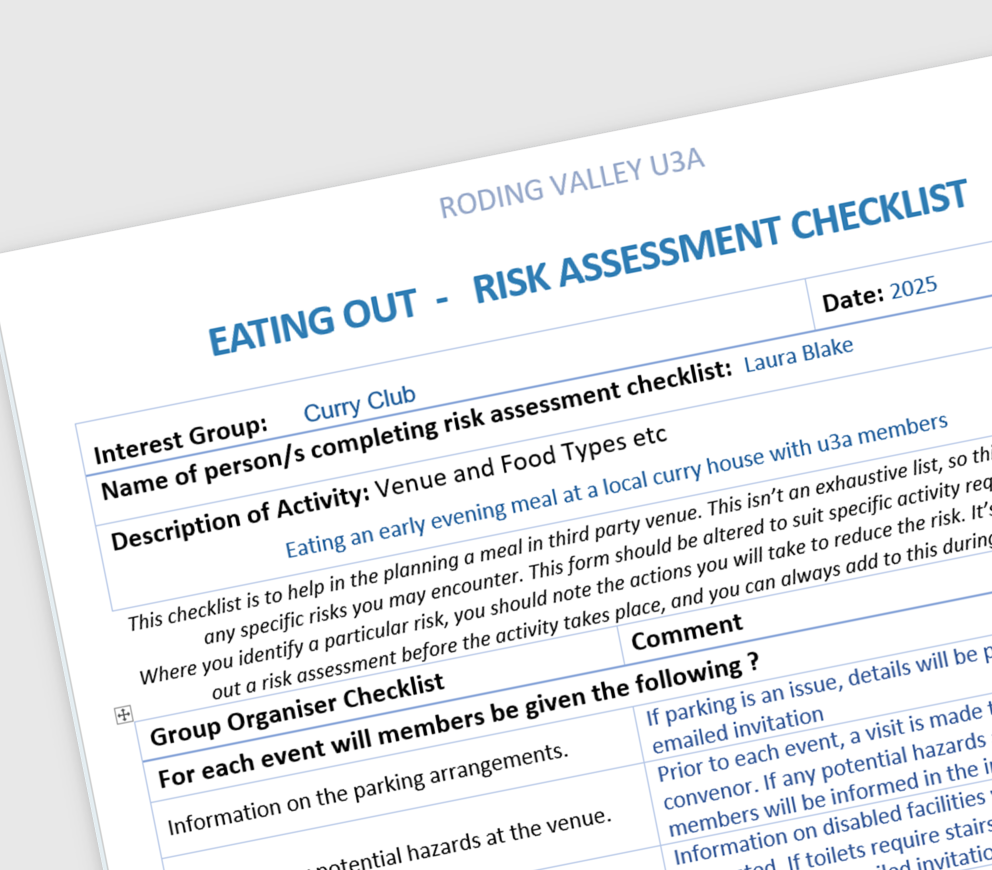
Group Convenors and those responsible for a meeting or event must complete appropriate risk assessment forms.
These will be used to identify any risks and explain how they are being mitigated or how the members of the Group have been informed about the risks.
Copies of all Risk Assessments must be passed to the Chairman who will ensure they are complete and they will be stored by the Secretary.
Roding Valley u3a is aware that some venues used for meetings/events may already have their own risk assessment, these should be reviewed and where mitigations identified, ensure they are actioned. E.g. a venue may state that no more than 5 chairs should be stacked together and or nothing placed in the way of fire escapes.
It is appreciated the level of risk varies dramatically from group to group (A book club in the village hall is normally less risky than rock climbing!) and the Proforma Risk Assessments below may need to be modified. All changes to the Proforma Risk Assessments, should be agreed with the Chairman.
Further guidance can be found in the Health and Safety Policy
The Third Age Trust advise all u3a trustees, convenors and event’s organisers to undertake risk assessments before commencing an activity. RV u3a has therefore provided the following links to the Proforma Risk Assessment Templates supplied by the Third Age Trust.
FREQUENTLY ASKED QUESTIONS
The u3a has also noted below a series of frequently asked questions relating to Risk Assessments
1. Why do I need to complete a risk assessment?
Risk Assessments are associated with the Health and Safety at Work Act 1974. While this does not apply to u3as as members are not at work, the insurance company expect u3as to take reasonable precautions through risk assessment checklists, and they use these as a basis of any claims made. If a member were injured, our insurance provider would ask for the completed risk assessment to be able to prove how the risk was identified. All groups should complete risk assessments to protect themselves.
For most activities, a checklist is sufficient. The more hazardous the activity, the more comprehensive the risk assessment checklist should be. the Trust has provided model risk assessment checklists for different kinds of low risk activities which u3as can adapt to their particular situations.
2. How often do I need to complete a risk assessment?
Best practice is to complete the appropriate risk assessment checklist at the beginning of each u3a activity, if there are any changes. However, we recognise this may not always be possible. At the very minimum, you should be completing or updating the appropriate risk assessment checklist in the following circumstances:
Home – based risk assessment checklist:
• Before the activity takes place in a member’s home for the first time.
• If the activity moves to another member’s home.
• If the member’s home changes in a significant way that would impact the u3a activity taking place or other member’s access (e.g., the addition of outdoor steps, building work).
• If any additional hazards or considerations have been identified since completing the last checklist (e.g., a new pet).
Venue – based risk assessment checklist:
• Before the activity takes place in the venue for the first time.
• If the activity takes place in a new venue.
• If the venue changes in a significant way that would impact the u3a activity, accessibility, or member safety (e.g., building work, a newly blocked off exit).
• If any additional hazards have been identified since completing the last checklist (e.g., new equipment.)
Online – based risk assessment checklist:
• Before each online activity with a new group and/or new host.
Day trip risk assessment checklist
• Before every day trip.
Holiday travel risk assessment checklist
• Before every holiday.
Outdoor sporting activity risk assessment checklist
• Before the activity takes place for the first time.
• If the venue or sporting area changes.
• if the group leader changes.
• if there are new members.
• if there are additional hazards that are identified since the last risk assessment checklist was completed.
Walk leader risk assessment checklist
• Before the activity takes place for the first time.
• If the route is different or new.
• If the group leader changes.
• If new members join the group.
• If additional hazards are identified since the last risk assessment was completed.
Personal member risk assessment
• If the member considers themselves to be vulnerable or requires adjustments to be made so they can participate in u3a activities.
• If a member considers their needs to have changed since completing the last personal member risk assessment.
• If a member wants to consider the risk to themselves for taking part in any u3a activity or event.
3. How long do we need to store each risk assessment checklist?
You should store each risk assessment for up to three years as this is the timeframe in which a claim can be made.
4. Do I need the day trip or holiday travel risk assessment checklist?
If your trip is over 24 hours and/or includes an overnight stay, then you should use the holiday travel risk assessment
Links
- Day trip risk assessment checklist
- Holiday travel risk assessment checklist
- Home based risk assessment checklist
- Online based risk assessment checklist
- Outdoor sporting risk assessment list
- Personal member risk assessment
- Venue based risk assessment checklist
- Walk leader risk assessment checklist
- Workshop Activity Risk Assessment List