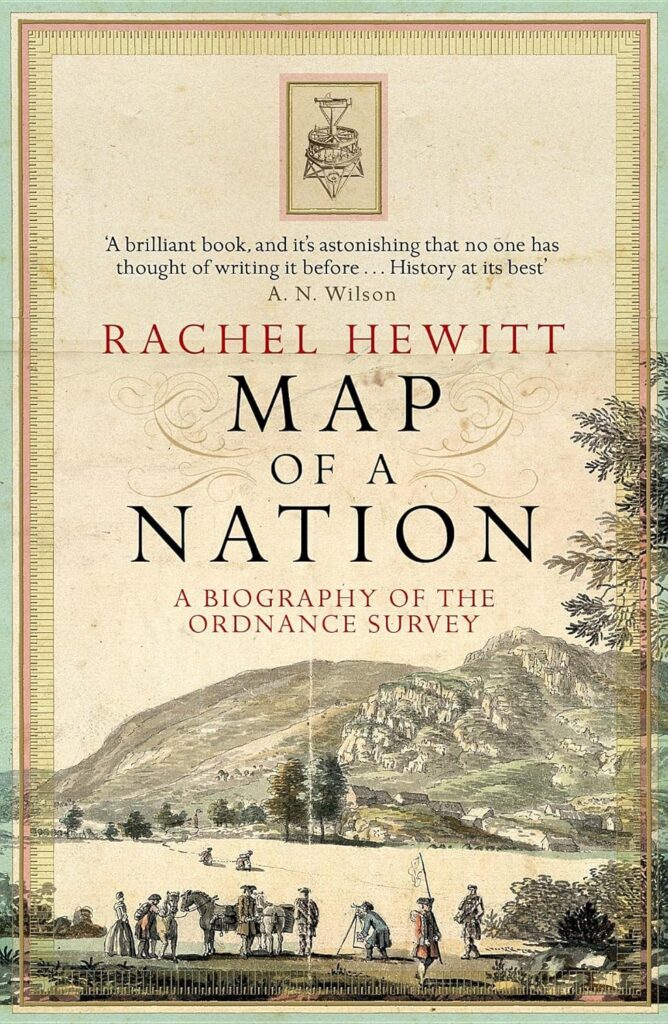
Tells the story of mapping Britain.
Focuses on the Ordnance Survey’s origins.
Shows how maps shaped national identity.
Explores science, war, and empire.
Highlights technical and human challenges.
Reveals mapping as a political act.
Connects geography with power and control.
Uses biographies of key surveyors.
Blends cartography with social history.
Reframes maps as cultural artifacts.
- Publication Date: 2021
- Pages: 430
- Cost £11
Our review in brief:
| 1. Rating: 6.6 out of 10 -Scores ranged from 5 to 8.5 |
| 2. Recommended: Although there were some interesting elements in the book, no one would recommend it. It was too long, too many characters were needlessly introduced and some sections, for example the time mapping Ireland were boring. One member commented "There were some good nuggets, but it needed determination to finish". |
| 3. Audience: It would really only suit someone who was very very interested in maps and charts. |
| 4. Strengths: It was an interesting read, in places and did provide an introduction to the history of Ordnance Survey. There were also some good "offshoots" for example, the difficulty if deciding on the actual name of a town, when there were numerous versions and spellings. |
| 5. Weaknesses: In addition to the points above, the book stopped in about 1870. It would have been more complete if it had explained how the map making had progressed over the last 150 years; particularly with modern technology. The sections on Wordsworth, Coleridge and Blake did not add anything to the history. Similarly, the physical descriptions and personal lives of the main characters also felt superfluous. As we commented about Paris 1944, these elements may have been included to try to make the book more appealing to non-historians. |
| 6. Other observations: The subtitle should have been the actual title, as the book only addressed the Ordnance Survey work and not the work undertaken by other map makers of the time. The book needed a good edit. One member said that they normally give a book away when they had finished reading it, but in this case, they could not think who to give it to. There was another comment that "the book would make a good present for someone you didn't like", which was a but harsh! |